Website on the Sherpas of Nepal
(updated 27/02/2026)
Nepal Research
Nepal Research Videos
Nepal Research Languages
Nepal Observer (ISSN 2626-2924)
Human Rights Forum Nepal (HURFON)
Hewa-Nepal
Sherwa mi
|
Sherwa mi Website on the Sherpas of Nepal (updated 27/02/2026) |
Websites: Nepal Research Nepal Research Videos Nepal Research Languages Nepal Observer (ISSN 2626-2924) Human Rights Forum Nepal (HURFON) Hewa-Nepal Sherwa mi |
 Himalayan Paradise Trek & Expedition (P.) Ltd. P.O. Box 23304, Kapan-8, Kathmandu, Nepal. Phone: +977-1-4823172, Cell: +977-1-9841212248 E-mail: info@himalayanparadisetrek.com Website: http://www.himalayanparadisetrek.com |
 Panorama Himalaya Trekking Pvt. Ltd. P.O.Box: 25301, Kathmandu, Nepal. Phone: +977-1-2297661, Cell: +977-1-9841426784 Website: http://www.panoramatrekking.com, E-mail: pasang2001@hotmail.com , kusang_sherpa2008@yahoo.com |
 Annapurna Foothills Treks & Expedition (P.) Ltd. Nursery Road, Lazimpat, Kathmandu, Nepal Phone: +977-1-4002200, Cell: +977-1-9841579429 Website: http://www.annapurnafoothills.com, E-mail: aftreks@gmail.com |
||||||||||||||||||||||||||||||||
|
||||||||||||||||||||||||||||||||||
|
Sherpa-English (pdf)
Sherpa-French (pdf)
Sherpa-German (pdf)
German-Sherpa (pdf) Sherpa-Italian (pdf, temporaneamente) Sherpa-English and English-Sherpa
Dictionary, by Nicolas Tournadre, Lhakpa Norbu
Sherpa, Gyurma Chodrak and Guilleaume Oisel, Kathmandu
2009 Nepali-English (pdf)
Nepali-German (pdf)
Schmidt's dictionary of modern Nepali
Indonesian-German (pdf)
Italian-German (pdf) French-German (pdf) |
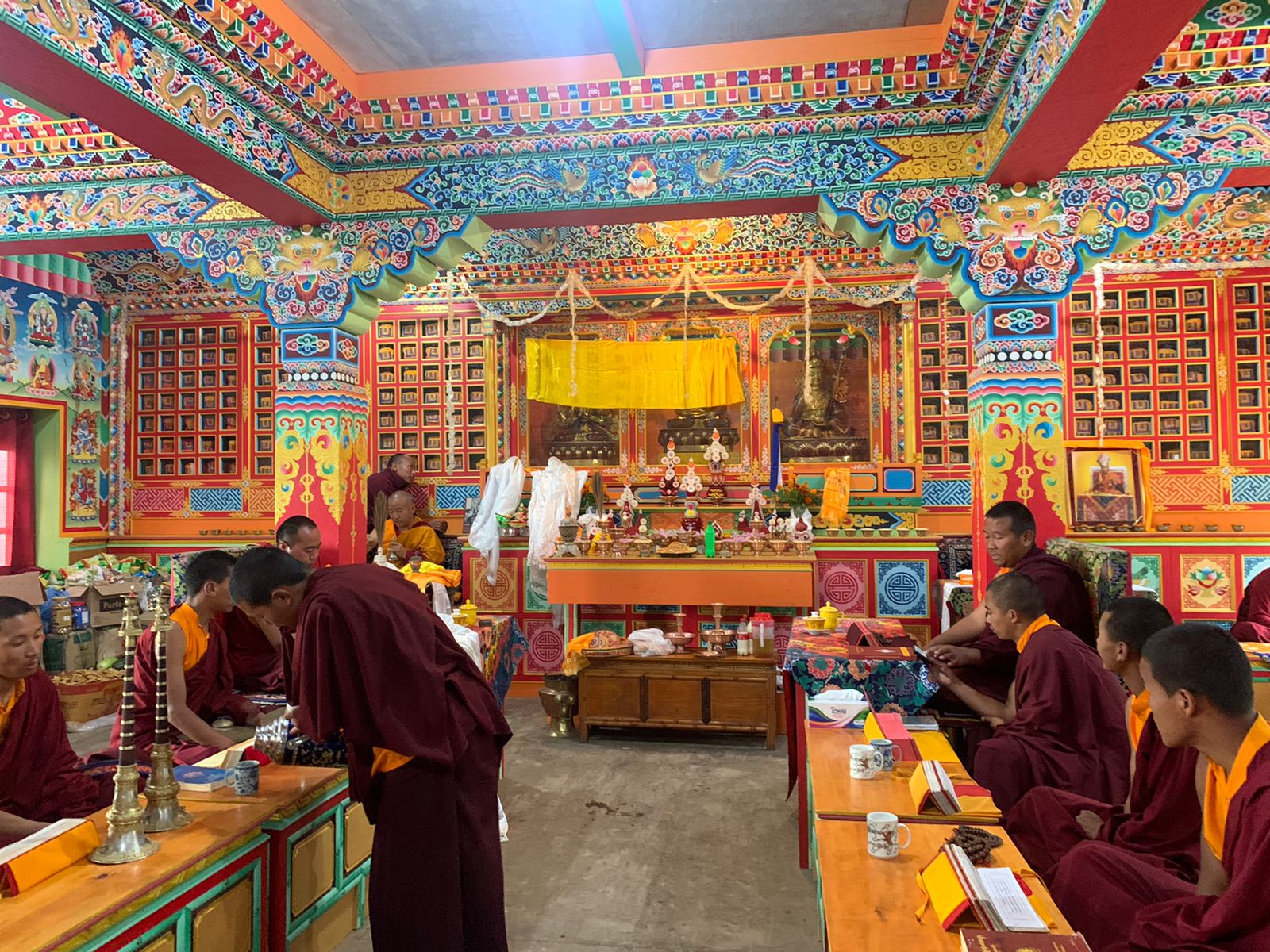
Inauguration of the new Gomba
on the upper floor of the community centre of Hewa,
Solududhkunda Municipality 1, Solukhumbu (October
2021)
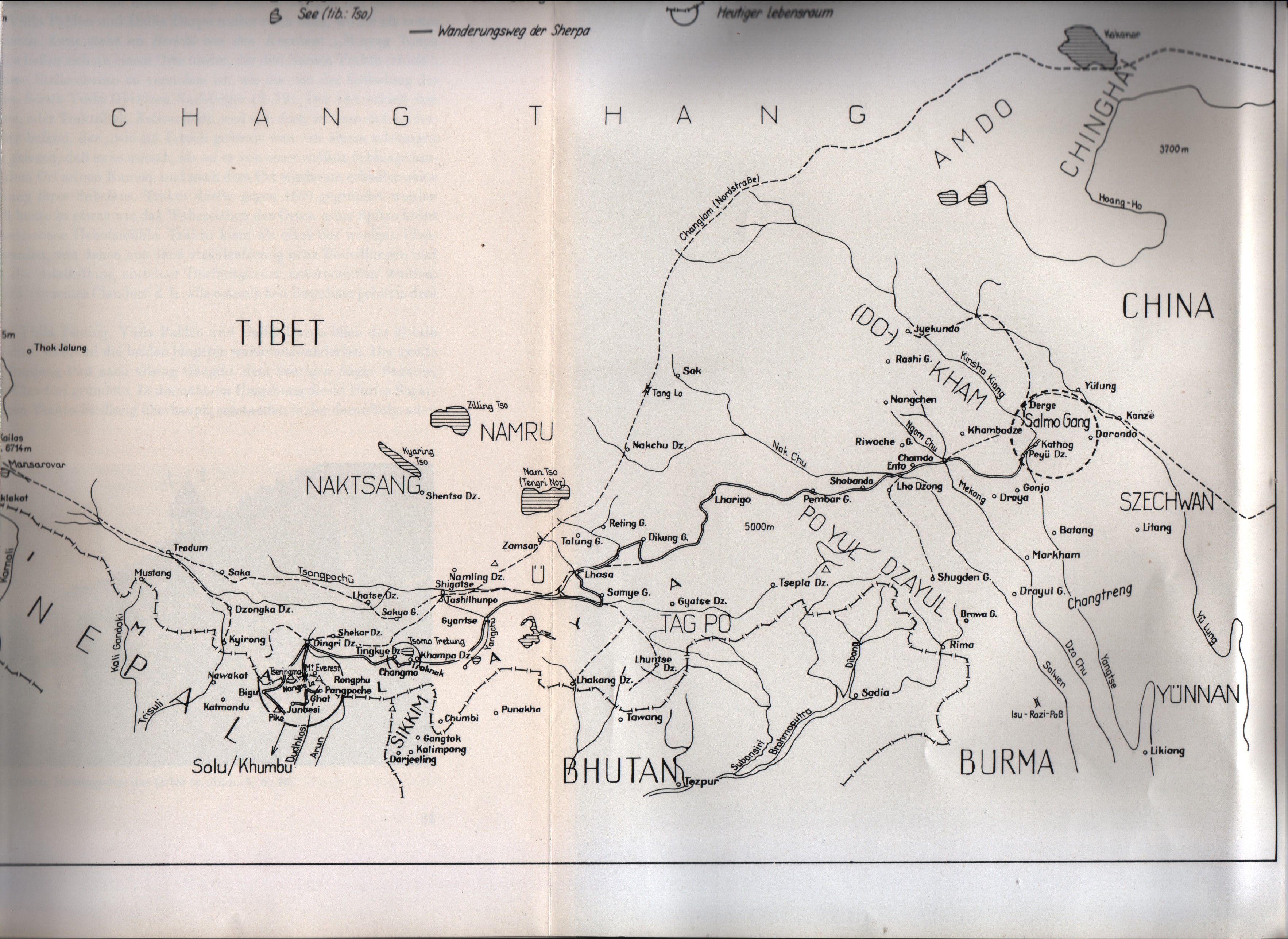
Short introduction: The Sherpas (originally Sherwa) are one of the numerous nationalities of the multiethnic state of Nepal. Their main living area is Solu-Khumbu in North-Eastern Nepal, Southwest of Mount Everest (sh.: Chomolungma, nep.: Sagarmatha). This traditional area has been divided several times by administrative measures of the Nepali state. Solu-Khumbu comprises three regions: Khumbu, Pharak and Shorong (nep.: Solu). The ancestors of the Sherpas immigrated from the East Tibetan region of Kham about 500 years ago (see time table and map). During the next centuries, some other Tibetan families followed them to Khumbu where they were integrated into the Sherpa society. By far the most Sherpas live in Shorong. Sherpa society is organized along exogamous clans. A hierarchical structure of society, as it is found among Nepal's Hindu castes, is totally strange to Sherpa society. According to the traditional kipat system, the whole Sherpa area was clan land of the Sherpas, i.e. the land belonged to the several clans and not to individuals. This clan land was expropriated with the abolition of the kipat system forced by the expanding Nepali state (final annulment in 1949). The Sherpa culture is based on the old Nyingmapa Buddhism interspersed with animist and shamanistic practices und conceptions. The Sherpa language is related to modern Tibetan, but only to a lesser degree mutually comprehensible. Since the Sherpa language is not a written and standardized language, the current elites endeavour to introduce a script on the basis of the Tibetan script, even though this alienates the Sherpa language which has developed independently from Tibetan over the centuries (see also experiment with Latin script on this Sherpa web site). Traditionally, the Sherpas live on agriculture and animal husbandry, supported by intra-regional trade. The trade with Tibet across the Nangpa La has almost been brought to a standstill by the politics of the Chinese occupying power in Tibet. A modern source of income is the tourism business. But only a few Sherpas have really made profits of this. Most of the Sherpas involved in the trekking business only find jobs as porters or guides. The access to these jobs is in Kathmandu. So today, many young Sherpas commute between village and capital. But the latter doesn't open broader perspectives for people from ethnic communities. |
Subsites: Background information on the Sherpas Sherpa
Monastery Route, by Freundeskreis
Serlo e.V. Institutions and organizations Nepal Research Videos, the video collection for all websites of Nepal Research Links: Nepal Research, website on Nepal and Himalayan Studies Yawa (Hewa), Dudhkunda Municipality 1 (formerly Taksindu VDC 6), Solukhumbu, Nepal: Development and history of a Sherpa village Sherpa Radio, a station presenting songs, music and dances of the Sherpas Nepal-Inzlingen, Hilfe für Kinder in Nepal Rheinland-Lorraine-Nepal e.V., Koblenz: Hilfe für Kinder in den Bergdörfern Nepals German-Nepal
Friendship Association, Cologne, Germany Nepalprojekt der Helene-Lange-Schule, Wiesbaden |